
Introduction
The tissue paper industry represents one of the most stable and profitable manufacturing sectors globally. With daily consumption across households, offices, hospitals, and restaurants, tissue paper products have become essential commodities. This comprehensive guide explores everything you need to know about starting and scaling a successful tissue paper manufacturing business.
Understanding the Tissue Paper Market
Market Overview and Growth Potential
The global tissue paper market continues experiencing robust growth, driven by increasing hygiene awareness, rising disposable incomes, and urbanization. India’s tissue paper market alone is growing at approximately 8-10% annually, creating substantial opportunities for new manufacturers.
Types of Tissue Paper Products
Successful tissue paper manufacturers typically produce multiple product lines:
Facial Tissues: Soft, absorbent sheets used for personal hygiene and sold in boxes or pocket packs.
Toilet Paper: The largest segment by volume, available in single-ply, double-ply, and premium variants.
Paper Napkins: Used in restaurants, cafes, and households, available in various sizes and qualities.
Kitchen Towels: Absorbent paper rolls for cleaning and wiping in kitchens.
Paper Handkerchiefs: Portable, disposable alternatives to cloth handkerchiefs.
Starting Your Tissue Paper Manufacturing Business
Initial Investment and Capital Requirements
Starting a small-scale tissue paper manufacturing unit requires an investment ranging from ₹15 lakhs to ₹50 lakhs, depending on production capacity and automation level. Medium-scale operations may require ₹1-3 crores, while large-scale manufacturing facilities need investments exceeding ₹5 crores.
Investment Breakdown:
The primary capital goes toward machinery (40-50%), raw materials (20-25%), infrastructure and building (15-20%), working capital (10-15%), and licensing and registration (2-5%).
Essential Machinery and Equipment
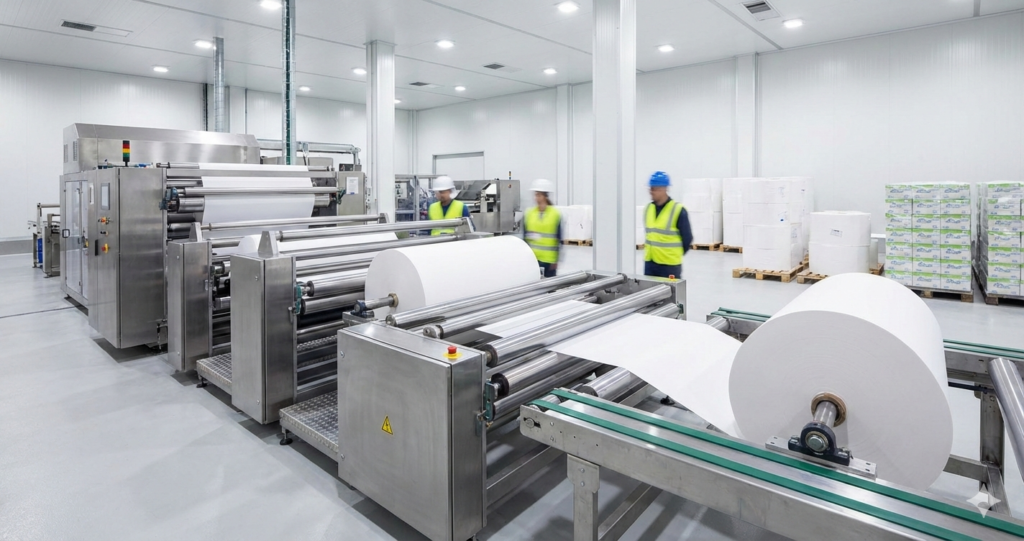
The core equipment for tissue paper manufacturing includes tissue paper making machines with capacities ranging from 50-200 kg per hour, paper slitting and rewinding machines for converting jumbo rolls, napkin making machines for folded napkin production, log saw machines for cutting rolls to size, and packing machines for final product packaging.
For small-scale operations, semi-automatic machines offer a cost-effective entry point with investment starting around ₹8-12 lakhs. Automatic production lines provide higher efficiency and consistency but require larger capital investment of ₹25 lakhs to ₹2 crores.
Raw Materials and Suppliers
The primary raw material for tissue paper manufacturing is parent jumbo rolls made from virgin pulp or recycled paper. Virgin pulp produces softer, higher-quality tissue suitable for facial tissues and premium toilet paper, while recycled paper offers cost advantages for economy-grade products.
Additional materials include:
Chemicals and additives such as softening agents, wet strength agents, and bleaching chemicals. Packaging materials including printed wrappers, cartons, and plastic films. Core pipes made of paper or cardboard for rolling products.
Establishing relationships with reliable suppliers is crucial for maintaining consistent quality and managing costs effectively.
Legal Requirements and Business Registration
Licenses and Permits
Operating a tissue paper manufacturing business requires several legal clearances. You’ll need business registration through proprietorship, partnership, LLP, or private limited company structures. GST registration is mandatory for manufacturing and selling goods. Trade license comes from local municipal authorities. Factory license is required under the Factories Act for units employing more than 10 workers. Pollution Control Board clearance ensures environmental compliance.
Additionally, depending on your scale, you may need an Udyog Aadhaar or Udyam registration for MSME benefits and ISI certification for quality standards, which builds market credibility.
Location and Infrastructure
Selecting the right location significantly impacts operational efficiency and costs. Industrial areas offer better infrastructure and easier regulatory approvals. Consider proximity to raw material suppliers to reduce transportation costs, access to major markets for distribution efficiency, and availability of skilled labor and technical support.
The facility should include production area with adequate space for machinery, raw material storage with climate control, finished goods warehouse, quality control laboratory, office and administrative space, and utilities including three-phase power supply and water connection.
Production Process and Quality Control
Manufacturing Process Overview
Tissue paper manufacturing follows a systematic process. Parent jumbo rolls are loaded onto unwinding stands, and the paper passes through slitting machines to achieve desired width. The paper is then rewound into smaller rolls with appropriate tension, converted into final products like napkins or toilet rolls, quality checked for softness, absorbency, and strength, and finally packed and labeled for distribution.
Modern machines automate most of these steps, ensuring consistent quality and higher production rates.
Quality Standards and Testing
Maintaining consistent quality is essential for building brand reputation. Key quality parameters include basis weight (GSM), tensile strength in both machine direction and cross direction, softness measured by hand feel test, absorbency rate for liquid retention, and brightness for visual appeal.
Regular testing using laboratory equipment helps maintain these standards. Many successful manufacturers obtain ISO 9001 certification to demonstrate quality commitment to customers.
Marketing and Sales Strategies
Target Market Segments
Tissue paper products serve diverse market segments. The retail consumer market includes direct sales through supermarkets and e-commerce platforms. The hospitality sector comprises hotels, restaurants, and cafes requiring bulk supplies. Healthcare facilities include hospitals and clinics with strict hygiene requirements. Corporate offices need regular supply for pantries and washrooms. Educational institutions represent another stable demand source.
Understanding each segment’s specific requirements helps in product development and pricing strategies.
Building Your Brand
In a competitive market, strong branding differentiates your products. Create a memorable brand name and logo that conveys quality and hygiene. Design attractive, informative packaging that stands out on shelves. Emphasize unique selling points like eco-friendliness, superior softness, or competitive pricing. Leverage customer testimonials and reviews to build credibility. Maintain consistent quality to encourage repeat purchases.
Distribution Channels
Successful tissue paper manufacturers use multiple distribution channels. Direct supply to retailers and supermarkets offers better margins. Wholesale distributors extend market reach with lower effort. E-commerce platforms like Amazon and Flipkart tap into online consumers. Institutional sales provide bulk orders with stable revenue. Export opportunities exist for manufacturers meeting international standards.
Starting with local markets and gradually expanding geographically works well for new manufacturers.
Financial Planning and Profitability
Cost Structure Analysis
Understanding your cost structure is crucial for pricing and profitability. Variable costs include raw materials (50-60% of production cost), labor for operations, packaging materials, power and utilities, and machine maintenance. Fixed costs comprise rent or building depreciation, administrative salaries, marketing expenses, loan interest, and insurance.
Efficient procurement, optimizing production schedules, and minimizing waste help improve margins.
Pricing Strategy
Tissue paper pricing depends on product quality, target market segment, competition, and brand positioning. Economy segment toilet paper is typically priced at ₹30-50 per roll, mid-range products at ₹60-100 per roll, and premium products at ₹120-200 per roll. Napkins and facial tissues command different price points based on sheet count and quality.
Analyzing competitor pricing while ensuring adequate margins typically yields prices 10-20% below established brands for new entrants.
Profit Margins and Break-even
Tissue paper manufacturing offers decent profit margins when managed efficiently. Gross profit margins range from 25-35% for economy products and 35-50% for premium products. Net profit margins after all expenses typically fall between 8-15%.
Most small to medium-scale units achieve break-even within 18-24 months of operation with proper market penetration and capacity utilization above 60-70%.
Challenges and Solutions
Common Industry Challenges
Tissue paper manufacturers face several challenges. Raw material price fluctuations impact profitability, requiring strategic inventory management and supplier relationships. Intense competition from established brands demands differentiation through quality or pricing. Working capital management needs careful attention due to credit sales cycles. Maintaining consistent quality at scale requires robust processes and training. Environmental regulations require investment in waste management systems.
Sustainable Manufacturing Practices
Sustainability is increasingly important for long-term success. Using recycled paper reduces environmental impact and costs. Energy-efficient machinery lowers power consumption and operating expenses. Water recycling systems minimize water usage. Biodegradable packaging appeals to environmentally conscious consumers. Proper waste management ensures regulatory compliance.
Manufacturers adopting sustainable practices often find premium market segments and better brand perception.
Scaling Your Business
Expansion Strategies
Once established, several growth paths exist. Increasing production capacity by adding more machines or shifts boosts revenue. Product diversification into related paper products spreads risk. Geographic expansion to new regions or states captures larger markets. Backward integration into raw material production improves margins. Forward integration with own retail outlets provides better customer control. Export markets offer higher realization for quality products.
Technology and Automation
Investing in advanced technology improves competitiveness. Automatic machines reduce labor costs and improve consistency. Computer-controlled systems optimize production parameters. Quality monitoring equipment ensures consistent standards. ERP systems streamline operations from procurement to sales. Digital marketing tools reach customers cost-effectively.
While automation requires capital investment, the payback through efficiency gains and quality improvement typically justifies the expense.
Conclusion
The tissue paper manufacturing business offers substantial opportunities for entrepreneurs willing to invest in quality equipment, maintain consistent standards, and build strong distribution networks. Success requires careful planning, understanding market dynamics, and commitment to continuous improvement.
Starting small with semi-automatic equipment, focusing on local markets, and gradually scaling up represents a prudent approach. With growing hygiene awareness and increasing consumption, the tissue paper industry promises stable growth and profitability for well-managed operations.
Whether you’re planning a small-scale unit or a large manufacturing facility, thorough market research, adequate capitalization, and focus on quality will position your business for long-term success in this essential industry.
Frequently Asked Questions
What is the minimum investment required to start tissue paper manufacturing?
A small-scale tissue paper manufacturing unit can be started with an investment of ₹15-25 lakhs, including machinery, raw materials, and working capital. This allows production of 2-3 tons per day.
How profitable is the tissue paper business?
Tissue paper manufacturing typically offers net profit margins of 8-15% after all expenses. With proper market penetration, a small unit can generate monthly profits of ₹1-2 lakhs after achieving stable operations.
What are the main raw materials needed?
The primary raw material is parent jumbo rolls made from virgin pulp or recycled paper. Additional materials include softening chemicals, packaging materials, and core pipes for rolling.
Do I need special skills or training?
While technical knowledge helps, most machinery manufacturers provide training for operations. Hiring experienced production managers and operators is recommended for maintaining quality and efficiency.
What is the market demand for tissue paper in India?
India’s tissue paper market is growing at 8-10% annually, driven by increasing hygiene awareness, urbanization, and rising disposable incomes. Per capita consumption remains low compared to developed countries, indicating substantial growth potential.
How long does it take to break even?
Most tissue paper manufacturing units achieve break-even within 18-24 months of operation, depending on capacity utilization, market penetration, and operational efficiency.
Can I export tissue paper products?
Yes, export opportunities exist for manufacturers meeting international quality standards. Middle Eastern, African, and Southeast Asian markets offer good potential for Indian manufacturers.